Gaussians Can Subtract
Neural Dissolve Fields for Hybrid Scene Rendering
1The University of Tokyo2Fuzhou University*Equal contribution
Overview
The mesh can be right in one view and wrong in the next
Hybrid Mesh–Gaussian rendering combines compact textured surfaces with flexible 3D Gaussian primitives. Existing hybrids follow an additive formulation, where Gaussian residuals compensate for errors left by the mesh. But not every Mesh–Gaussian conflict is caused by missing content: residual geometry errors, occlusion mismatch, texture-projection artifacts, and view-dependent appearance can make the same mesh content consistent in one view but inconsistent in another.
We therefore formulate hybrid rendering as a multi-view inconsistency problem and present Gaussolve, a subtract-and-refill framework. A lightweight Neural Dissolve Field, parameterized by scalar spherical-harmonic Gaussians, learns where and from which viewing directions mesh content should be dissolved. Continuous transmittance fusion progressively exposes the residual Gaussians behind it, preserving their gradients and avoiding hard visibility switches. The result is higher visual fidelity with fewer Gaussians and faster rendering.
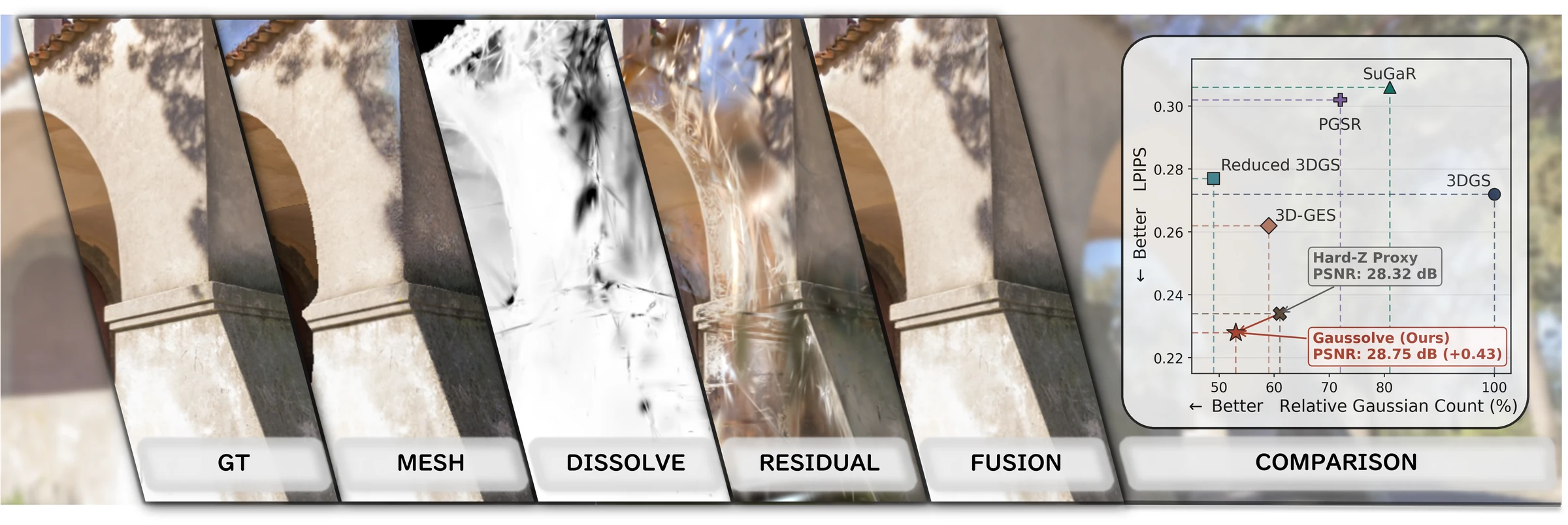
On Deep Blending, compared with 3DGS
Method
Subtract what conflicts, refill what is revealed
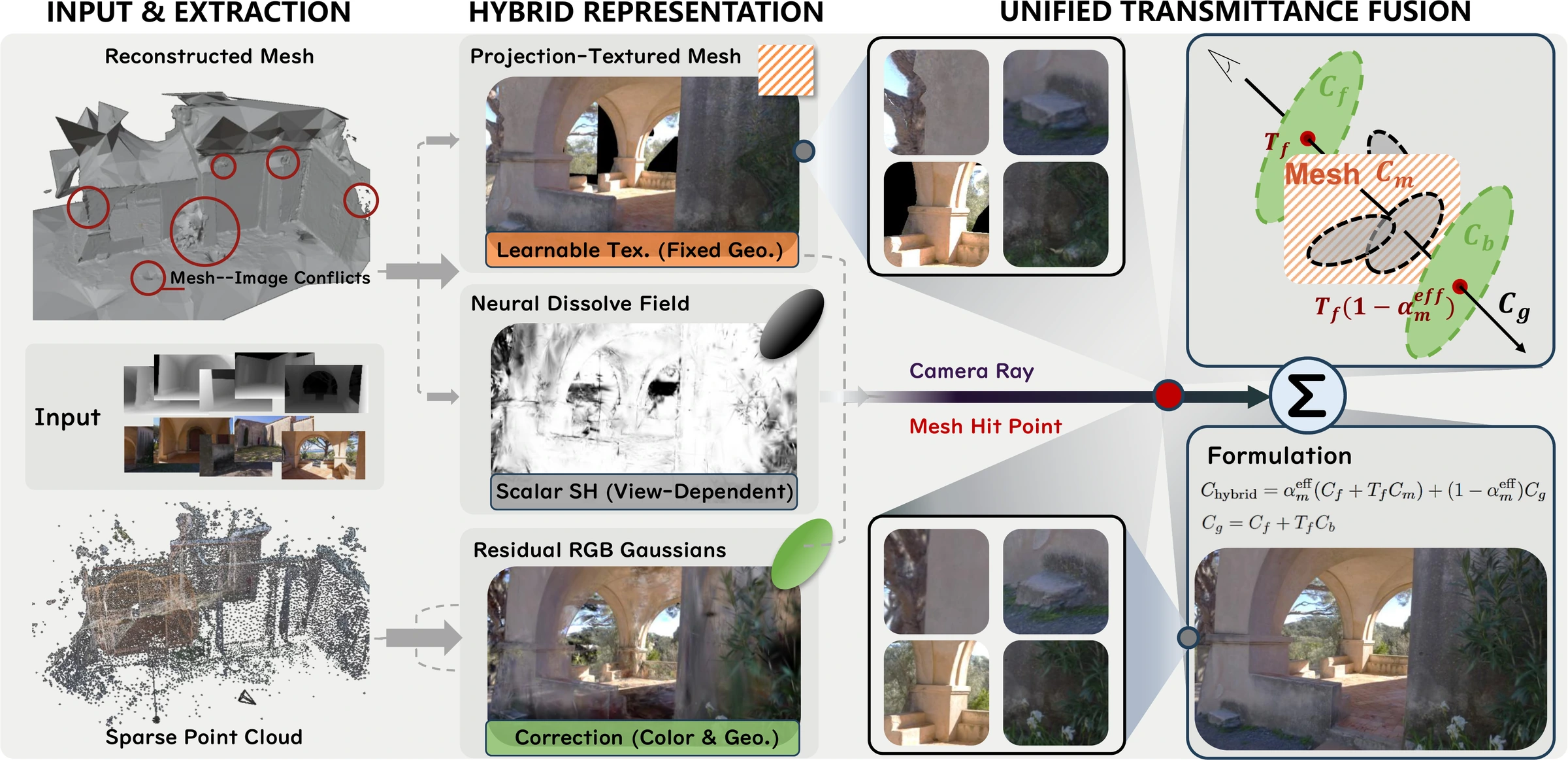
Projection-textured mesh
Training images are projected straight onto an independently reconstructed mesh, keeping the observed high-frequency appearance.
Neural Dissolve Field
Scalar-SH Gaussians predict how much of the mesh to dissolve, and from which viewing directions.
Continuous transmittance fusion
Dissolving the mesh smoothly exposes the residual Gaussians behind it, so they keep learning instead of being cut off.
- Final pixel color
- Effective mesh opacity: 1 keeps the mesh, 0 hands the pixel to the Gaussians
- Dissolve value predicted by the Neural Dissolve Field
- Color of the projection-textured mesh
- Color and transmittance of the Gaussians in front of the mesh
- Full rendering of the residual Gaussians
Explore
Subtract and refill, layer by layer
Drag to compare any two layers, or step through the four stages.
Hard visibility vs. continuous fusion
With the same textured mesh, a Hard-Z hybrid treats the mesh as an opaque occluder. Gaussolve dissolves what is inconsistent and lets the Gaussians fix it.
Why hard visibility fails
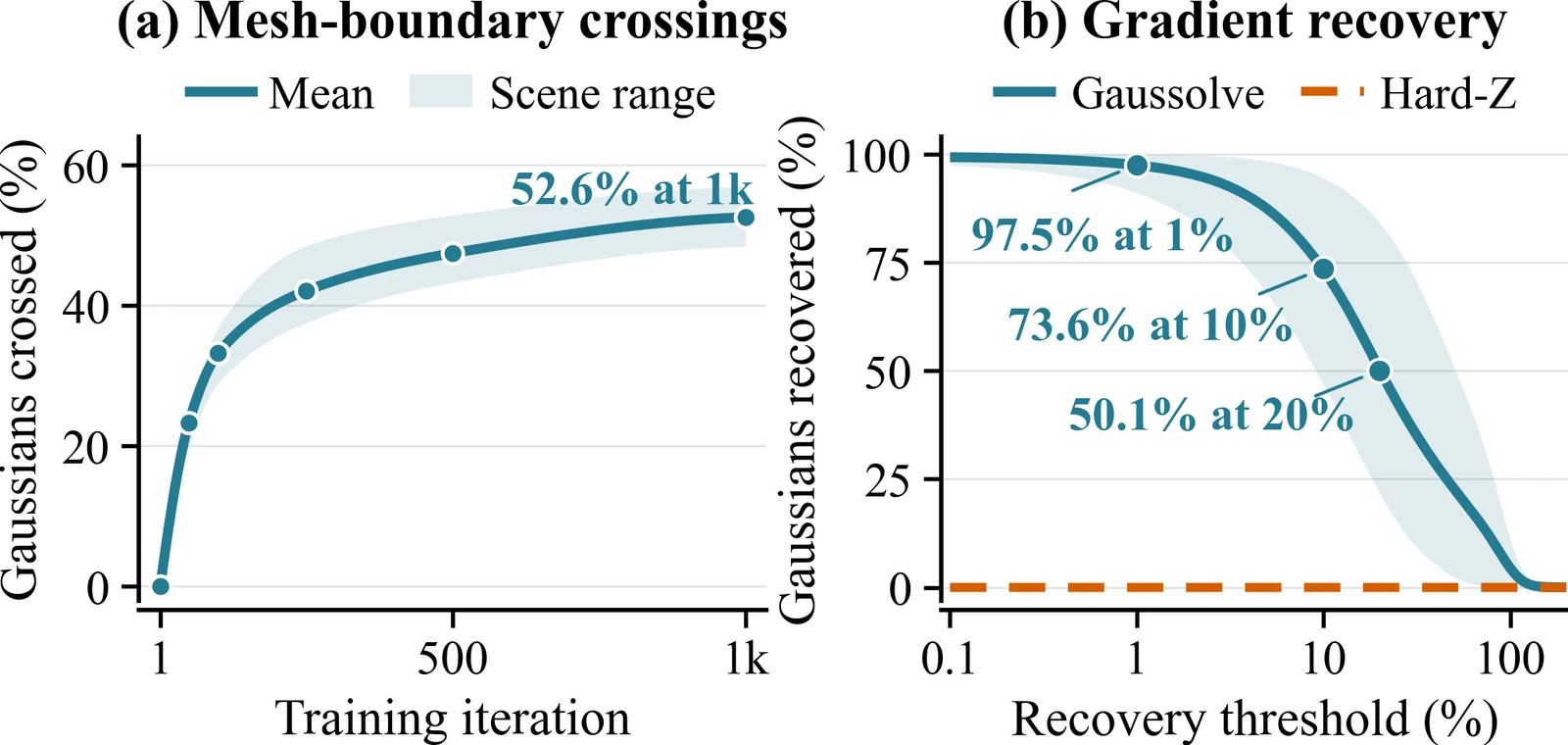
During training, Gaussians keep crossing behind the Hard-Z mesh boundary, and every crossing cuts off their reconstruction gradient.
Continuous fusion keeps those Gaussians visible to the optimizer and recovers most of the blocked gradient.
Dissolve that depends on the viewing direction
With scalar SH, the field dissolves the mesh only from the directions where it conflicts, so the Gaussians can recover highlights and reflections.
Results
Better quality with fewer Gaussians
Gaussolve improves every Gaussian backbone it is plugged into.
| Method | Mesh | Hybrid | PSNR ↑ | SSIM ↑ | LPIPS ↓ | ΔGS ↑ |
|---|
Against published hybrids Deep Blending
| Method | PSNR ↑ | SSIM ↑ | LPIPS ↓ | ΔGS ↑ |
|---|---|---|---|---|
| MeshGS | 29.65 | 0.900 | 0.245 | ~30% |
| Hybrid Mesh-Gaussian | 29.56 | 0.895 | 0.259 | 36% |
| Gaussolve | 30.31 | 0.894 | 0.232 | 59.5% |
Rendering efficiency Deep Blending
| Storage | FPS | Memory | |
|---|---|---|---|
| Full renderers | |||
| 3DGS | 0.655 GB | 99 | 1.64 GB |
| Gaussolve | 0.336 GB | 168 | 1.70 GB |
| Gaussolve (parallel) | 0.336 GB | 174 | 1.71 GB |
| Gaussolve components, rendered alone | |||
| Mesh | 0.069 GB | 1003 | 0.98 GB |
| Dissolve Gaussians | 0.016 GB | 1110 | 0.09 GB |
| Residual Gaussians | 0.251 GB | 265 | 0.77 GB |
Citation
BibTeX
@inproceedings{wang2027gaussians,
  title     = {Gaussians Can Subtract: Neural Dissolve Fields for Hybrid Scene Rendering},
  author    = {Wang, Yiyan and Liu, Haohan and Shibuya, Tetsuo},
  booktitle = {Proceedings of the IEEE/CVF Winter Conference on Applications of Computer Vision (WACV)},
  year      = {2027}
}